Avowed Review (PS5)
| Developer | Obsidian Interactive |
| Publisher | Xbox Game Studios |
| Platforms | PS5, Xbox Series S, PC |
| Release Date | February 18, 2025 (and then for Playstation a year later) |
| Completed? | 31 hours |
(Dis)Respect to Microsoft
Microsoft is great at cultivating mixed feelings:
- They did fund a spin-off for this niche series that was likely not going to be a blockbuster (in fact, Pillars of Eternity 2 did not net a profit for a long time after release)
- They simultaneously decided that they should withhold the Playstation 5 release of Avowed. Were they expecting this game would move Xbox units?
Weirder still, Xbox Game Studios didn’t delay the PS5 release of Ninja Gaiden 4 at all, and truthfully that game probably had a bigger audience. Is this special treatment specific to their larger-scale RPGs? They did the same thing for Starfield (well, actually that PS5 release was delayed by three years), but that was a Bethesda title that actually had some hype.
Regardless, I still have to give some kudos to Microsoft for keeping this series alive. Even if I didn’t love this entry, it’s commendable to let Obsidian revisit the Pillars franchise.
The Pillars Cinematic Universe
Before I can start to talk through my feelings about Avowed, I must come clean: I hated Obsidian’s most comparable first person RPG, The Outer Worlds. It felt like someone had started to build the familiar sandbox of Fallout, and gave up after getting 20% of the way there. What remained was a bland combat system, a world that felt like the set of a movie rather than a living place, and grating characters. Despite playing the game through Game Pass, I still felt like I had been saddled with a financial loss after investing ten hours into the game. I say this now because I know that The Outer Worlds was relatively well-received and it’s the studio’s most similar work. If my reaction to that game seems out of line, then you probably don’t want to read the rest of this review.
On the other hand, I loved Obsidian’s Pillars of Eternity. Like many other Zoomers, I was thirsting for more games like Baldur’s Gate 3 after losing over a thousand hours in my first CRPG, Pillars was at the top of most lists of recommended CRPGs for beginners. I bounced off of it on my first playthrough (Act I can be a little unstructured) but I returned a few months later and lost myself in the game. The isometric perspective is limiting, sure, but the writing was top-notch and the combat was mechanically deep and engaging. I had some gripes with some of the encounter design a bit further into the game, but the feeling of exploring the world and slowly unravelling a conspiracy was unrivaled.
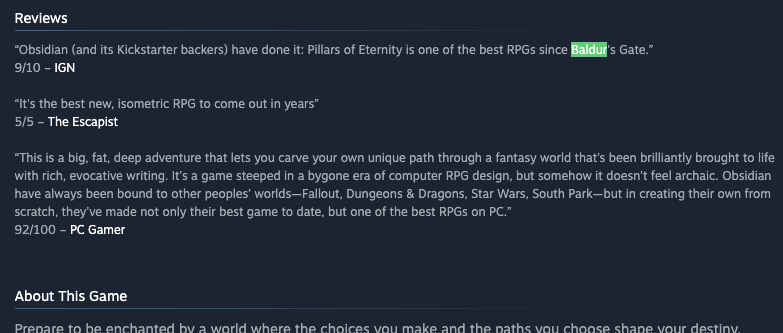
The World of Eora, the setting of Pillars of Eternity that is shared by Avowed, strikes a very unique balance. The original Pillars marketed itself as a spiritual successor to Baldur’s Gate (I & II), and both from a lore and mechanical perspective, the swords-and-sorcery influence is definitely there. What distinguishes Pillars, however, is the mature tone and very weighty atmosphere of the world. The game opens to bodies dangling from a tree and a scourge of mothers birthing children without souls. This is certainly more mature than a bald man yelling about a hamster, but despite that, there is enough levity in the writing and optimism in the characters that it never feels GrimDarkTM. The story does not moralize either, and you, as a player, are forced to reconcile the realities of this universe with your own values that you are role-playing. I really liked how the game tackles the practice of animancy, the often dangerous and ethically-questionable science of the souls, and as I made progress through the game, I never felt like I was making the “right” choice – the best I could do was making the choice that I personally felt like minimized the harm. This goes well beyond Paragon vs. Renegade and the “wheel of four of the exact same dialog options” that became popular post-Dragon Age. Instead, all choices and dialogues are painted with shades of grey and ambiguity.
 |
|---|
| The inspiration for Pillars is no secret, and it’s happily displayed on the Steam page |
In short, the World of Eora is distinctly human, whether you’re engaging with deities or peasants.
The World of Eora: Now In 3D
The presentation as Avowed boots up is familiar, and it’s still beautiful. Pillars had a very distinctive design language, which is important for a game that has spent much of runtime in dialogues and menus. The typography is pleasant, yet stylized, and the color palette is a unique tan-and-teal that’s easy on the eyes. You’re immediately treated to the beautiful painted artwork that was a necessity in the isometric perspective, but is now a defining visual flourish for the series. After you’ve made your character (who must be a God-like this go-round) you’re dropped onto the beach of the Living Lands as an Envoy for the emperor of Aedyr. The new visuals are vibrant and colorful, but the speakers on your TV will blow out as the sound of the waves crashing against the beach hits 4000 decibels no matter what your volume is set to. If you can hear him, you can chat with your companion on the beach and get a feel for the dialog.
The biggest quirk of the new dialog system is how your character fits into the scene. Rather than the classic Oblivion approach where the head of the person we’re talking to fills the entire screen with a small palette of choices at the bottom, Avowed takes a more cinematic approach. This is usually okay, but the shot-reverse-shot presentation makes it hard to tell if you’re in a cutscene or part of the conversation. Sometimes it feels as though every participant in the conversation is intentionally avoiding eye contact. Out of the blue – seriously, it happens in maybe one out of ten conversations – the camera will suddenly swap to a third-person shot of your character. The first time it happens, it feels like a jump scare. They stare blankly into the camera, with no emotions or affectations, and it’s especially jarring since they don’t speak. I don’t mind a silent protagonist appearing physically within a dialog scene (I mean, I have 1,300 hours in Baldur’s Gate 3), but it feels like the camera perspective aimed at your character must have been a very late addition to the dialog system during development. It’s jarring and unnatural.
As the story progresses, you learn more about the Living Lands, the overreaching colonialism of the Aedyran empire that you are supposed to represent, and the guerilla authoritarians that they’ve chosen to “assist” with their project on the island. You are tasked with investigating a mysterious infection in the Living Lands that turns Kith into fungus zombies, but the tensions on the island will not make this easy. You’ll quickly be embroiled in local politics and forced to pick sides, defusing (or igniting) the impending war between the factions. I was pleasantly surprised at how much of an impact my choices actually seemed to have (I think I still have some lingering trauma from how unimportant choices were in Dragon Age: The Veilguard) and the ambiguous morality of the different factions felt accurate to the series. While it certainly does not reach the peaks of the prior games, there is a weight and consequence to what you say and how you act. Besides the political struggle, you’ll also unravel which god is responsible for your birth as a God-like, which is no longer a common occurrence at this point in the setting.
The simulation of Eora, while high-definition, is truthfully not much more advanced than what we saw in the isometric perspective, and in some cases, it’s even more limited. Most NPCs walking around can’t be interacted with, and most interactable NPCs have little to say. You can’t be a murder-hobo, and you can’t be a thief. It’s very hollow and simple, but I don’t necessarily think it’s a dealbreaker, it’s just the nature of the scope that the developers were shooting for. What certainly worked against this game was early rumors that it would be a Skyrim-killer, and early reviews and coverage espoused frustration that the world was not reactive in the way that people wanted. I don’t think Avowed expects you to spend hours wandering the streets of its cities, and it certainly doesn’t want you to push its sandbox to the limits. If you are okay with that, it’s perfectly acceptable, just don’t expect to get even Outer Worlds levels of reactivity. A great example of this is the bathhouse: in Pillars II, the Bathhouse is a bustling environment, there are some rooms you can loot, and people to talk to. In Avowed, the bathhouse houses maybe six NPCs, all of whom have nothing to say after you’ve completed a single quest for the owner.
Companions
The companions in the previous Pillars of Eternity entries have been memorable, and I might even go as far as to classify some of those characters as legendary. Sure, there were heartthrobs like Edér, but there were also complicated characters like Durance, who is presented as a hateful maniac and even his own god has abandoned him. The companions existed all over the spectrum, and I found my experience with most of them to be memorable and distinct. Especially when we compare Pillars to the old Baldur’s Gate, the companions shine were deep and well explored. All of these flawed individuals share their perspectives along your journey, and the internal and external conflict they bring with them paints a lot of context onto the setting, and it may even help you find your own moral compass amidst the chaos in Eora.
Unfortunately, I cannot say the same about Avowed. There are a total of four companions in the game and I would argue only two of them are worth talking about. The small cast is acceptable given that only two companions can follow you during gameplay, but unfortunately the lack of quantity did not create quality. Companions can only be talked to at your camp, and they will very rarely have anything to say in dialogues in the main game world. They can level up, and they do have special combat abilities, but the combat plays more or less the same with or without them. And finally, they each get their own questline, but the quality is rather varied. It’s hit or miss all the way down, and I would argue that it ultimately averages out around mediocre. Unlike its predecessors, there is almost no conflict between the companions and your goals, and it didn’t seem like they were written to clash in any interesting way. The lack of tension becomes palpable by the end of the game, and it makes everyone feel like the Envoy’s sycophants.
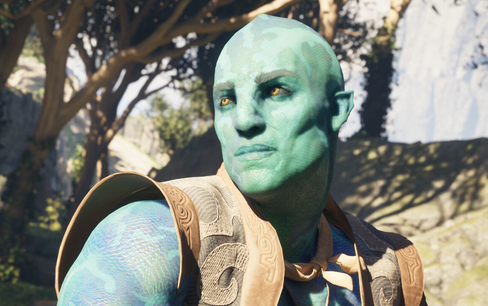
We’ll start with the good. Kai is the first companion you’re given, and he is by far the most thoroughly written character. Kai is a Rauatai, and he found his way to the Living Lands looking for a second chance after deserting his post in the Rauatian military. I felt like his voice acting and writing reflected this ex-military aesthetic very well, and peeling back the layers of his story was interesting. You find out that his biggest regret is not deserting, but instead losing a close friend (and lover). His side quest slowly unravels this insecurity and grief in a very mature and engaging way. Kai feels like a real person for the most part, and I kept him as my main companion for the vast majority of the game. Across my playthrough, Kai was the only companion that ever seemed to take issue with my decisions as Envoy, which was refreshing. He’s also the only romance option in the game, though the companion system is so limited I’m surprised anyone noticed – even his romance is largely relegated to a slide in the post-game slideshow. Nitpicks aside, Avowed is elevated by Kai, and I think he’s one of the best parts of the story. I felt organically driven to help him in his side because I wanted to know more.
 |
|---|
| My boyfriend, Kai |
Remember three sentences ago when I commended Kai’s voice acting and writing for feeling authentic? Marius is the opposite, and if I were to score this game on a point system out of ten, I would happily dock two entire points simply because Marius exists. Marius is a dwarven ranger that has fled his home and lives as an exile from his community. Marius’ character is brooding and grumpy, and his voice actor has a distinct American accent. That’s not notable, though. What is notable, however, is that Marius talks like a smarmy Redittor, and he is afflicted by a bizarre mixture of a mid-western accent combined with a non-stop onslaught of fantasy slang shotgunned across every sentence of his dialogue. Every other word is “bleste”, meaning “damned,” and every third word is “nimdut”, meaning “idiot.” It infects every part of his dialog, and the accent combined with this forced flavor is truly repulsive to the ears. No attempt was made to deliver these fantasy words in a more appropriate or fluid way. I don’t blame the voice actor here at all, as the story even reveals that Marius canonically used to have an accent from his upbringing but lost it. That means that the writers and director were aware of the incongruity and ultimately they made a choice to keep it. It was the wrong choice, undoubtedly. Maybe the voice acting was so jarring that it biased me against Marius permanently, but I found the writing of his character to be off-putting at best, and just like I dreaded every time I had a camp dialogue with Marius, I was ecstatic when the game let me leave his ass in camp after I was forced to keep him in my party for a handful of missions.
The other two companions aren’t offensive or bad, but they ultimately felt unimportant, almost as though they were supposed to be temporary companions at some point. Giatta is a talented animancer that you meet in the Emerald Stair that is in the midst of a conflict with the leader of her settlement over her experiments. Yatzli is a flirty scholar that you also meet in the Emerald Stair, and she’s in a long-term relationship with Giatta’s mentor. I found Yatzli’s personality to be much more interesting and her character design – a fuzzy pink Orlan – stood out a fair bit more than Giatta. Unfortunately for both characters, their alignment is almost indistinguishable, and they are both introduced in rapid succession. This is a confusing choice as it makes the characters blend together, and this would have otherwise been an opportunity to introduce more inter-party conflict. Instead, we’re given two characters that are from the same place, they know the same people, and they largely believe the same things. It’s a brutally safe choice, and the lack of tension becomes more noticeable as the Envoy’s choices become more and more consequential but never seem to upset anyone to any notable degree.
Ash Chase has a fantastic video on her channel that explores the companions in more depth if you’d like a deeper dissection of the writing. While you’re at it, subscribe! Her channel is incredible, and it has somehow always manages to discuss the games that are on my mind (Baldur’s Gate 3, Dragon Age: The Veilguard, Absolum, etc).
Exploration & Combat (Again and Again)
The opening hour of Avowed is, for better or worse, representative of how the vast majority of your time in the Living Lands will play out. You’ll pick up one of a few types of weapons for each hand, and then you’ll start blasting and slashing your way through Xaurips. There are a number of dual-wielding or two-handed options available, and each is given basic and charged attack variants. You can also pick up grimoires which always go in your left hand and allow you to cast from a list of four spells without needing to invest in learning the spells. Finally, you’re given a basic dodge backwards, left, or right that can be used to avoid damage, or a parry if you’d prefer. After combat, you can use your absurdly high jump and parkour skills to climb around the (strangely blocky) environment. I found the platforming aspect to be very polished, and there was maybe only a single time over the course of the entire game where I felt like this system unfairly caused a death for me. This dance of combat and vertical exploration will make up 90% of your time in Eora this go-round, and while it leaves a good first impression, the fact that it doesn’t evolve too far beyond this is disappointing.
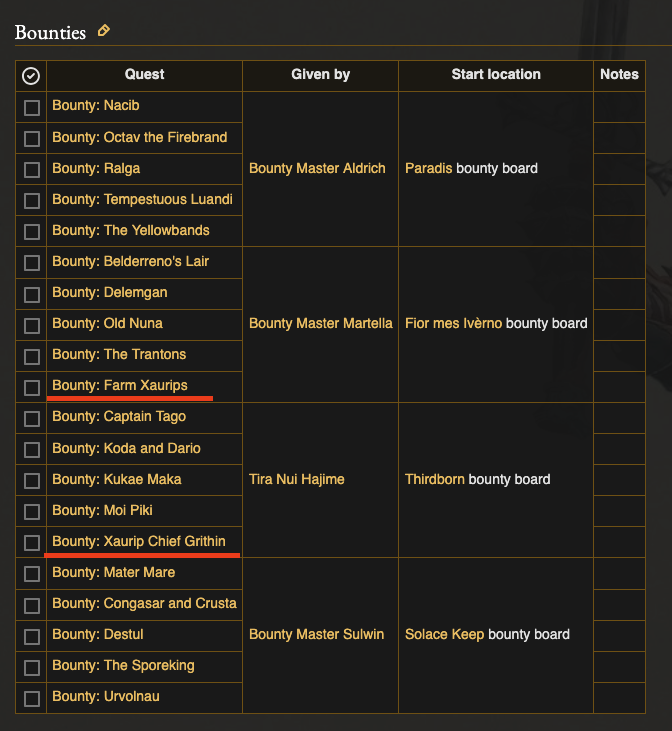
The first problem is enemy variety. Xaurips are basically the Pillars version of Kobolds from D&D, and based on the volume of them you’ll see in this game, you’d think they must be the primary force of evil across all of Eora. Seriously. I would estimate that a third of the combat encounters in Avowed are against this same enemy type, granted they do get souped-up stats as the game progresses. Given that these were level 1 trashmobs in the past games, it’s jarring that Avowed continues to scale them so wildly to match your level rather than introducing something else. Once your character has power-creeped into the endgame, you’ll still encounter Xaurips that are just as difficult to defeat as the first Xaurips you ever encountered, and they remain a constant (and annoying) threat. The remaining cast of enemies isn’t much better, and I would largely bucket them into either “humanoids” and “undead.” There are other types of enemies, but they barely register when compared to the hoards of these other three groups. And seriously, Xaurips are the majority. It’s absurd.
 |
|---|
| In case you can’t get enough of them during regular gameplay, you can even do Xaurip bounties… |
The exploration aspect, at least for me, also became grating. Each region is huge, but past the first region of the game, I started to find more and more objectives that were surrounded by rocks and cliffs that just so happened to have the wrong shape for parkour. This transformed my objectives from “go to this place and do the interesting thing” into “jump against every rectangular outcropping in a two mile radius until you find the one that is actually intended for climbing.” The loot rewards were also very underwhelming, and towards the end of the game I had fully given up hope that I would find anything interesting off the beaten path. I mostly blame this on the crafting system for weapon and armor upgrade. I like crafting weapon upgrades well enough, but finding an ultra-rare chest in a hidden cave only to be rewarded with enchanted pieces of wood feels more akin to opening my junk drawer and finding a two-year-old packet of Chick-fil-a sauce than it does the conclusion of an epic adventure. There are also unique weapons and armors to be found, but so many of these could be found in plain sight, right next to objectives, that I realized I was more likely to find interesting gear in really obvious places, rather than as a reward for exploration and platforming. The ludicrous resource investment required to get a weapon or armor up-to-par with where you are in the game also discourages switching weapons very frequently, making the more interesting finds less mechanically viable anyway.
Finally, I found that the seams of the moment-to-moment combat systems began to show very quickly. Since enemies can appear outside of your field of view, your screen is constantly covered in flashing red and yellow indicators to show you where attacks are coming from, making the game look more like a space ship simulation rather than a fantasy RPG. Your allies will also shout to give you warning of incoming attacks with a supernatural sense of direction. Kai will yell “WATCH YOUR LEFT” from another zip-code, with his eyes closed, submerged in a pit of lava, without ever calling out the wrong direction relative to where you’re facing. You’ll eventually notice that the enemies have a super stilted tracking and animation system – perhaps to compensate the blind-spots inherent to first-person melee combat – that is off-putting and feels unfair. You can have a ludicrous amount of space between you and the enemy, but if they’ve started an attack animation already, you’ll see them supernaturally slide 100ft across the arena so that the attack will connect. I’ve never seen a combat system work like this. You have to choose between last second dodges or parries, even when it makes no visual sense that your spacing would not be viable. The enemies float around like puppets and between that, the absurd number of indicators on screen at all times, and your allies’ constant directional warnings, it just feels so artificial. You can turn some of the indicators off in the settings, but you’re likely just making the game harder for yourself as these are fundamental to how they’ve designed the combat.
The feeling of the combat gameplay is only worsened by the dodge. Besides the aforementioned unnatural enemy movement, which can punish creating distance in strange ways, re-using the jump button for dodging was a true war crime of game design. Every single game with an I-frame dodge has been training me to dodge towards the enemy for most of the past decade, and honestly, Avowed’s combat isn’t good enough or fun enough to justify bucking the convention. In a game with a better dodge, e.g. Dark Souls, you can dodge directly into an enemy to avoid a single, short attack and create an opening. Alternatively, a diagonal dodge past an enemy is a great way to avoid a longer attack where the enemy is rushing towards you, and it creates some space using their momentum. Avowed throws this away, and it seems like it was solely for the sake of saving space on the controller. You can only dodge laterally or backwards, and worse, this is a first person game. This means that the game is restricting you to only dodge into your blind spots, and I constantly found my character getting trapped on geometry that I couldn’t see while simultaneously getting swarmed by hoards of enemies. Other times, I’d forget about the bizarre directional restriction and find myself unintentionally performing a gentle leap directly into enemy damage. I think they had enough real estate on a controller that this jump/dodge hybrid was not at all necessary, and I cannot understate how unpleasant this limitation becomes, especially in the more cramped arenas you’ll find yourself in.
I’d be remiss not to remark on the bosses, if only to remark that they are largely unremarkable. All of the bosses effectively act as health sponges, but given that every other enemy is a health sponge anyway, they hardly stand out. To make them even less memorable, most boss arenas are flooded with tens of trashmobs, likely because there was no other way to introduce a challenge against a single enemy with the design of the combat. What really hurts these bosses further is that a lot of them are effectively just minor variations of regular enemies, maybe with some minor visual flourishes. For example the first boss you fight, an enraged bear, turns out to be a regular enemy once you leave the tutorial island.
Progression
The progression in Avowed is split into the same two categories as most RPGs: character abilities attained on level-up, and gear upgrades. The former is quite a letdown, at least when compared to the prior entries in the series. In Pillars I & II, the player picks from a set of distinct classes that included both the familiar (barbarian and ranger) and the unfamiliar, specific to the world of Eora (cypher and chanter). Pillars II even went a step further and offered some basic multiclassing on top of this system. As you leveled up, you would receive the numerical upgrades that are standard for an RPG, but you’d also be presented with a pretty large skill tree that offered a lot of customization. I personally really liked this approach, and while it wasn’t the most flexible class system in the world, each class offered a distinctive play style and there was plenty of room for player expression within each skill tree.
Avowed eschews classes for all intents and purposes. You are presented with three skill trees at each level for three “classes” of ability: wizard, fighter, ranger. There are no restrictions on how you distribute your points, and you’re likely going to pick and choose across all of the different disciplines. That sounds like it should be more flexible than the class system I described, at least on paper. In practice, however, the three skill trees are pretty small, and I didn’t feel like any of the abilities significantly changed the gameplay – certainly not to the extent that I would want to replay the game for a different “build.” All of the spells and abilities are also attached to irritatingly long cooldowns like an MMO, so a spell will feel the same as a martial ability and vice versa. In summary:
- The wizard tree is mostly spells, and with the grimoire mechanic in the game, the primary reason to level this tree is to unlock later grimoire spells.
- The fighter tree is a mind-numbing list of primarily numerical upgrades to the mediocre melee combat.
- The ranger tree sits somewhere in-between with a mixture of active spells and abilities as well as combat upgrades.
I will give credit where it’s due and praise that the game does all you to respec for a small amount of gold whenever you’d like, but it unfortunately reinforced my disappointment in the skill tree systems. The skill trees hardly function to add distinct gameplay experiences, and the only “distinct” feeling I had was that the fighter tree was terrible. The other letdown is that these skill tree represent the three most generic classes in the game, yet there are plenty of classes specific to the universe that would have added a lot more flavor and variety. I can imagine a Chanter tree, where you can pick verses of songs that buff you and your allies or summon monsters to aid you, or a Cypher tree, where you can use psychic abilities in combat. All of this is much easier said than done, but instead we’re left with a handful of same-y combat skills on cooldowns.
The other half of the progression system is the gear upgrades, and this is even more underwhelming. As mentioned, most of what you’ll find during exploration is upgrade materials, and you can upgrade weapons and armor at your camp. For the most part these are straightforward damage and defense increases, though grimoires do get reduced cooldown times. These numerical increases are strictly required for a pleasant gameplay experience (unless you enjoy spending a whole minute wailing on a Xaurip), but the volume of materials you need to collect progressively skyrockets into tedium. The game also caps the rarity of upgrade materials within regions to gate you from getting overpowered without progressing the game. Mercifully each region increases the base level of all equipment you’ll find while looting, for the most part, but I still felt discouraged from using new weapons and items that I found after the halfway point in each region since it was hard to stomach investing so many upgrade materials.
The unique items, if you can afford to level them up accordingly, are almost always better than the standard items in a strictly numerical sense. These will typically add one or two extra effects, either defensive or offensive. Leveling this gear is identical to other items, but there’s another type of upgrade available: enchantments. This system is comically undercooked. Just like a regular upgrade, you approach the special location in your camp for enchantments, but you’re presented with a whopping two choices for enchanting your weapon. The options are usually either a straight upgrade to the extra damage type on the weapon, or a more situational condition to trigger some effect. But that’s it. That’s the entire system. You can’t even change the enchantment on a weapon later on. The options you’re given are rarely very noticeable anyway, but since this system uses a different progression of random crafting materials, enchantment is almost always less “expensive.”
Between the limited skill trees and the boring loot, I felt no desire to replay the game on New Game Plus. I appreciate that they offer the option, but there is very little here that makes me want more.
Kai, Your Eyebrows are Sparkling!
The technical state of Avowed on its anniversary is a mixed bag. The art design in the game is truly fantastic and some frames of this game are picture-esque, but the presentation is marred by the worst ray tracing artifacts I’ve ever seen in a game, regardless of changing my settings from “Performance” to “Quality.” Well, it was the worst artifacting I’d ever seen, but I did play Crimson Desert a month or so later. The state of Crimson Desert was was horrendous on launch, so don’t interpret that as a compliment to Avowed.
Somehow, the graphical problems are at their worst in dialogues. This is mind boggling to me, given that this is so central to the role playing experience. Hair – usually eyebrows – sparkles and shimmers in every dialogue. Kai’s eyebrows in particular are very sparkly, but every NPC seems to have their own graphical problem that results in a TV-static-like appearance, or strange blurriness. It’s not the end of the world, but it definitely does the art direction a major disservice. Usually I only see this type of problem on reflective surfaces like water in other games, where it doesn’t matter and it stays out of the way. In Avowed, these artifacts are unavoidable and taint some of the most important moments across the entire experience. I’m also mystified that this happened on PS5. There are a whopping 2 hardware profiles for this console, and despite that, they couldn’t find a way to make this game look less muddled on the “lowest” hardware setup. Did it look this bad on the Xbox?
Graphical quirks aren’t the end of the world, but crashes are. To this day, I don’t think they’ve patched a crash that occurs roughly 50% of the time when you use fast-travel. This is egregious. I lost a fair amount of progress on multiple occasions before learning this is a Known IssueTM. The remainder of my playtime was hampered by anxiety that using a quality-of-life feature would crash my game. Sometimes I’d roll the dice and get lucky, sometimes I’d lose progress, and other times, I’d just opt to walk.
Pillars of Eternity: The Veilguard
Games take many, many years to develop, and it’s not surprising that we occasionally see uncanny reflections of one game in many others years down the road. If you’re curious why 2025 was mostly Souls-likes and/or parry-focused action games, just check the date: in 2019, Sekiro dominated the charts with a mixture of Souls-like combat and parrying, and over the next five years, developers worked to try and capture their own lightning in a bottle with a clear inspiration. It was almost certainly not obvious to these studios how saturated that space would be by the time their own games were to be released.
I can’t put my finger on what exactly the inspiration was, but this type of parallel thinking appears to have happened between Avowed (2025) and Dragon Age: The Veilguard (2024). Both games were originally set to be multiplayer/live-service titles and both games experienced a significant rework to become single-player games. Both games are descended from real-time-with-pause RPGs. Both games feature a vibrant color palette with bold splashes of purple. Both games have a (literally) colorful cast of characters, criticized for being less fleshed-out than other titles in their respective series. Both games center around a corruption taking over the world. Both games expose companion abilities as a wheel that pauses time and can be used for both combat and puzzles. Both games limit you to two companions in the field. And finally, both franchises are indirect descendants of Bioware’s Baldur’s Gate (1998), with Dragon Age being Bioware’s break from the tyranny of Wizards of the Coast after making Baldur’s Gate II and Neverwinter Nights, and Pillars of Eternity proudly claiming to be a spiritual successor to Baldur’s Gate.
I think you could force the same type of comparison for any two games, but it feels so eerily similar in this case that I thought it deserved mention. They both seriously fumbled aspects of their legacy, but there is an undeniable quality lingering in both games. Honestly, if you could transplant the story and tone of Avowed into Veilguard it’d be an 8⁄10, and if you could transplant the combat and presentation of Veilguard into Avowed, it’d be an 8⁄10. It’s tragic that neither game could reach their potential, and I do worry that they are each a nail in a coffin.
While it doesn’t affect Avowed as acutely, it also could not be foreseen years in advance that the foundations of the role playing game genre would be totally rattled by Larian’s Baldur’s Gate 3. The expectations for writing, gameplay, and companions jumped through the roof and a clear signal was sent to the industry that turn-based RPGs can actually succeed. Again, even this is a strange and ironic echo of Bioware’s own legacy over twenty years later, to have the revival of their old IP used as a benchmark for quality. I have to wonder how different Avowed and Veilguard would be if their pitch was delayed until after the release of Baldur’s Gate 3. Would they have stuck closer to their roots? Would they have leaned more into characters and writing? Or would they have strayed further to try and avoid retreading the same ground as the unexpected titan of their genre?
Conclusion
While the story and setting kept me focused on seeing the game through to the end, I found Avowed baffling by the end of my experience. The world was indeed interesting, but the companions failed to fill the shoes of their predecessors and the combat failed to evolve in any meaningful way from the opening hour. The combat in this game is very central to the experience, and depending on your preferences, you’ll either find this to be a fun 40ish hour romp or a 40ish hour grind. Personally, I was so bored by fighting the same swarms of zombies and Xaurips that I started rushing past encounters with the invisibility spell towards the tail end of the game. I don’t enjoy first person combat very much, so this may be an artifact of my own tastes rather than an objective failing.
Regardless, I think Avowed is a missed opportunity, and I really hope Obsidian gets the chance to take another swing at this IP some day. If you’re a die-hard Scrolls-LikeTM fan (Skyrim, Oblivion, Fallout 3), you might fall in love with Avowed, but for everyone else, I would strongly recommend playing Pillars of Eternity instead. It’s not as pretty, but the setting is still incredible and I found the gameplay systems to be much more engaging. Obsidian has even released an update to the game in the past few months that introduces a turn-based mode, if the old real-time-with-pause gameplay was not your cup of tea.
 RSS
RSS